Transaction Intelligence
My Role — Sole UX Lead · Lab49 for Commonwealth Bank of Australia · 6-week PoC · Deliverables: UX strategy, dynamic UI system, conversational AI flows, trust score framework, path-to-production document ·
Industry Recognition — Finalist, 2025 Amazon Nova Partner Demo Competition
The Problem
One of Australia's largest banks was losing ground to its own self-service platform. Over 11,000 calls per month — 14% of total business banking volume — were coming in for issues that should have been resolvable without human support. Inquiries took up to two weeks to process with no automated updates. The technology existed to do better. The design thinking didn't yet.
The Design Challenge
This wasn't a standard dashboard problem. The UI needed to respond differently for every transaction, every user, and every intent. There was no fixed screen to design — there was a system to design. Three problems needed solving simultaneously: surfacing the right transactions without overwhelming the user; presenting AI-generated analysis credibly without creating alarm; and reducing cognitive load at exactly the moment a customer is most anxious.
The Design Response
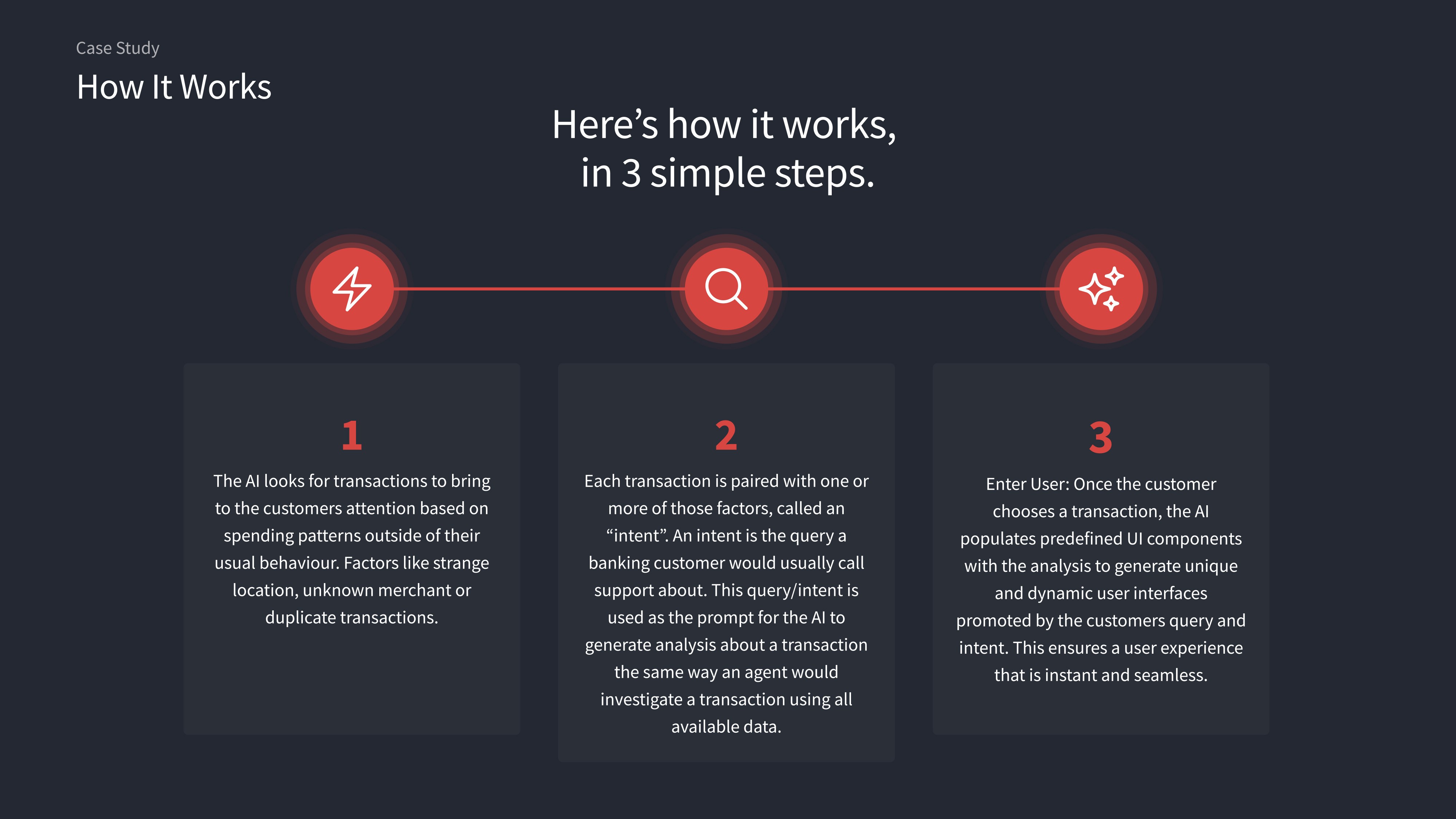
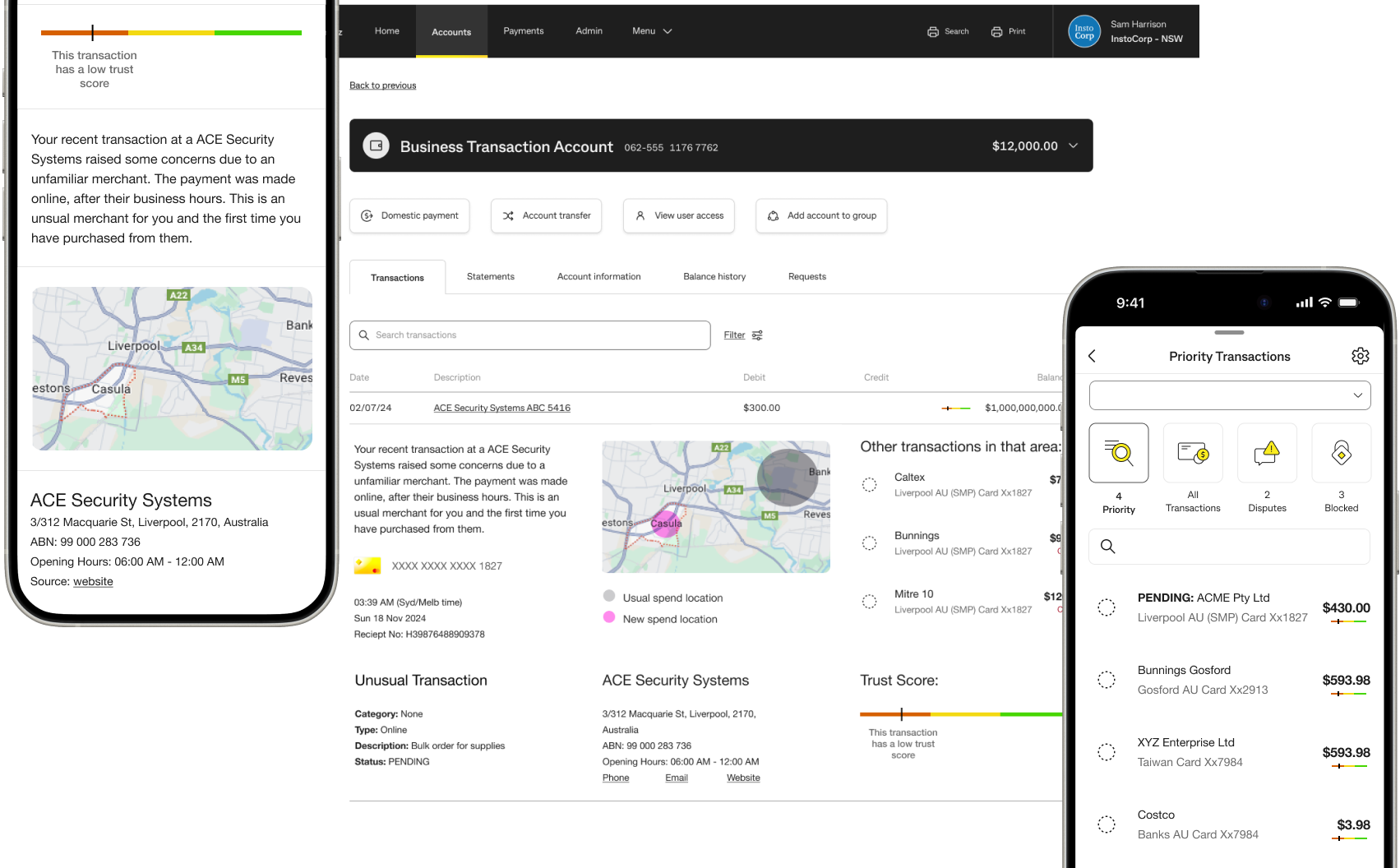
The solution centered on Transaction Intelligence — a priority-first view using AI to identify which transactions genuinely need attention, based on behavioral patterns, merchant familiarity, location, and risk signals.
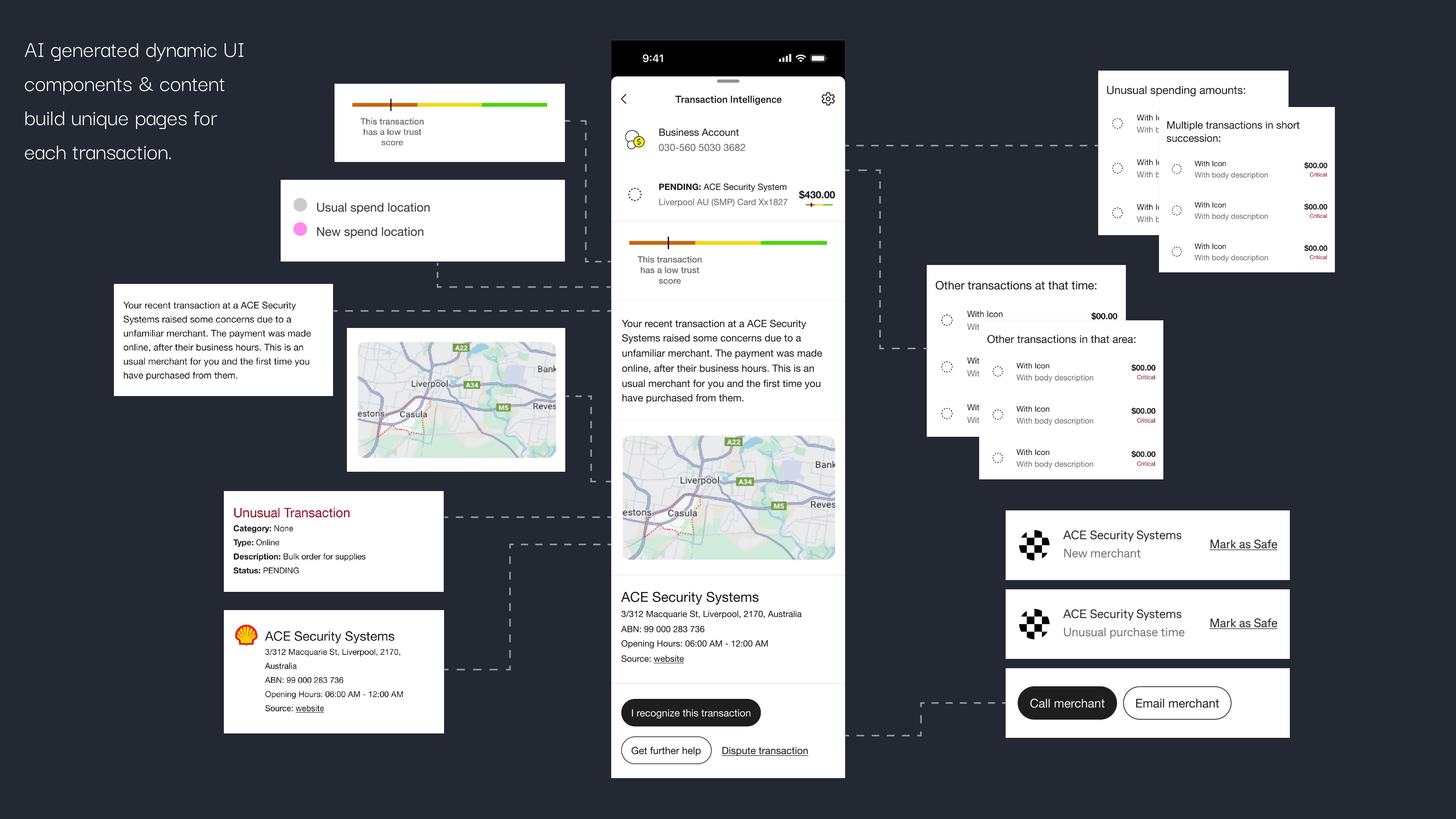
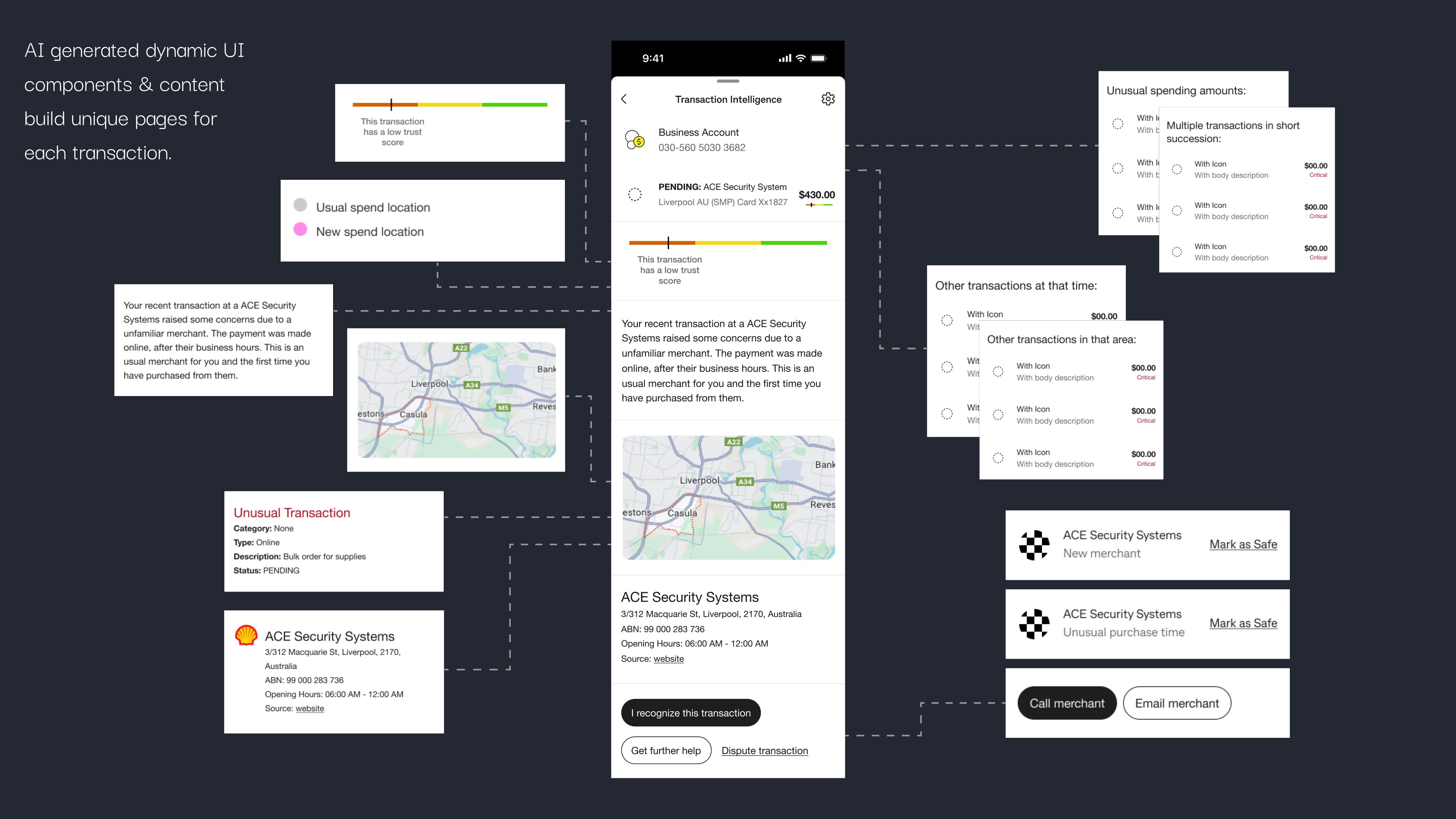
Each flagged transaction was paired with an "intent" — the specific reason a customer would normally call support — which prompted the AI to generate a bespoke analysis assembled from all available data. The result was a dynamically generated screen for each transaction: not a template, but a genuinely contextual experience.
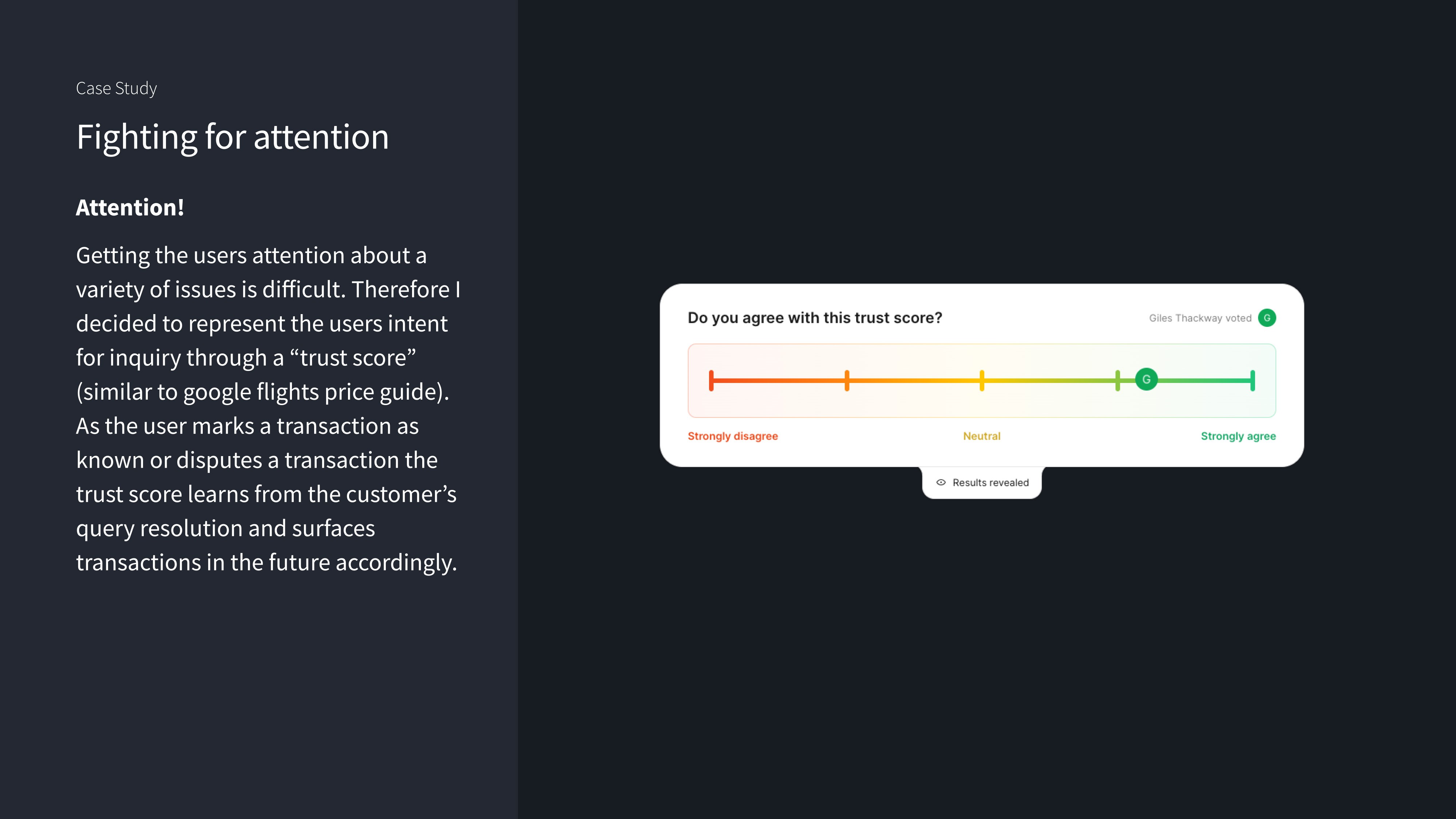
To make risk legible without creating alarm, I introduced a trust score — a visual spectrum inspired by consumer heuristics like Google Flights — that communicated confidence at a glance and learned from user resolutions over time.
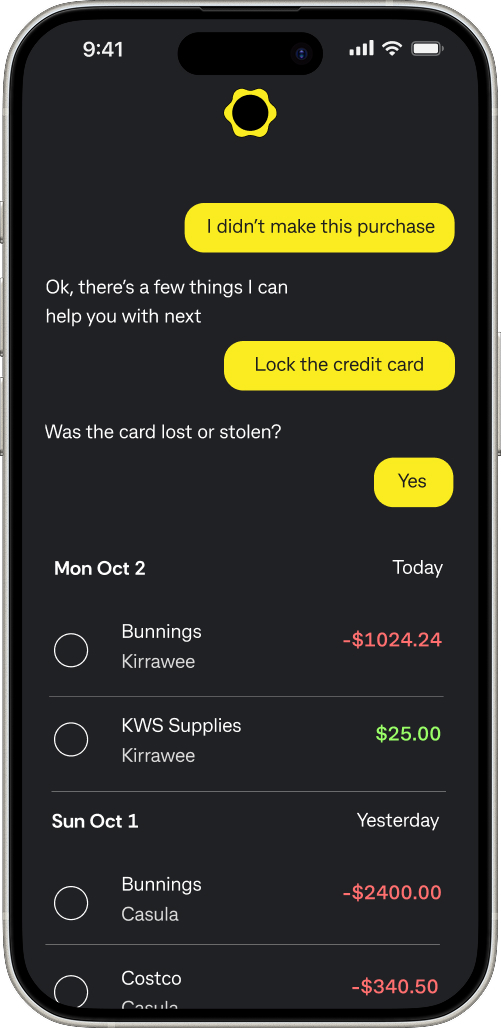
A conversational AI layer handled escalation — disputes, card locking, further help — through natural language, without requiring a call.
Outcome
The six-week PoC was completed on schedule with strongly positive executive feedback and went on to be recognised as a Finalist in the 2025 Amazon Nova Partner Demo Competition — one of the most competitive showcases of generative AI innovation in the industry. A Path to Production document was delivered covering data integration, security hardening, accessibility, and channel integration. Follow-on workshops were scheduled to move the concept toward production.
As the sole UX designer on Lab49's award-recognised GenAI financial platform, the engagement demonstrated something important: that AI in financial services doesn't have to feel impersonal or intimidating. Designed well, it can be the most reassuring thing a bank puts in front of a customer.
Full design documentation available on request. Sensitive client information withheld for confidentiality.

Transaction Intelligence
My Role — Sole UX Lead · Lab49 for Commonwealth Bank of Australia · 6-week PoC · Deliverables: UX strategy, dynamic UI system, conversational AI flows, trust score framework, path-to-production document ·
Industry Recognition — Finalist, 2025 Amazon Nova Partner Demo Competition
The Problem
One of Australia's largest banks was losing ground to its own self-service platform. Over 11,000 calls per month — 14% of total business banking volume — were coming in for issues that should have been resolvable without human support. Inquiries took up to two weeks to process with no automated updates. The technology existed to do better. The design thinking didn't yet.
The Design Challenge
This wasn't a standard dashboard problem. The UI needed to respond differently for every transaction, every user, and every intent. There was no fixed screen to design — there was a system to design. Three problems needed solving simultaneously: surfacing the right transactions without overwhelming the user; presenting AI-generated analysis credibly without creating alarm; and reducing cognitive load at exactly the moment a customer is most anxious.
The Design Response
The solution centered on Transaction Intelligence — a priority-first view using AI to identify which transactions genuinely need attention, based on behavioral patterns, merchant familiarity, location, and risk signals.
Each flagged transaction was paired with an "intent" — the specific reason a customer would normally call support — which prompted the AI to generate a bespoke analysis assembled from all available data. The result was a dynamically generated screen for each transaction: not a template, but a genuinely contextual experience.
To make risk legible without creating alarm, I introduced a trust score — a visual spectrum inspired by consumer heuristics like Google Flights — that communicated confidence at a glance and learned from user resolutions over time.
A conversational AI layer handled escalation — disputes, card locking, further help — through natural language, without requiring a call.
Outcome
The six-week PoC was completed on schedule with strongly positive executive feedback and went on to be recognised as a Finalist in the 2025 Amazon Nova Partner Demo Competition — one of the most competitive showcases of generative AI innovation in the industry. A Path to Production document was delivered covering data integration, security hardening, accessibility, and channel integration. Follow-on workshops were scheduled to move the concept toward production.
As the sole UX designer on Lab49's award-recognised GenAI financial platform, the engagement demonstrated something important: that AI in financial services doesn't have to feel impersonal or intimidating. Designed well, it can be the most reassuring thing a bank puts in front of a customer.
Full design documentation available on request. Sensitive client information withheld for confidentiality.

Transaction Intelligence
My Role — Sole UX Lead · Lab49 for Commonwealth Bank of Australia · 6-week PoC · Deliverables: UX strategy, dynamic UI system, conversational AI flows, trust score framework, path-to-production document ·
Industry Recognition — Finalist, 2025 Amazon Nova Partner Demo Competition
The Problem
One of Australia's largest banks was losing ground to its own self-service platform. Over 11,000 calls per month — 14% of total business banking volume — were coming in for issues that should have been resolvable without human support. Inquiries took up to two weeks to process with no automated updates. The technology existed to do better. The design thinking didn't yet.
The Design Challenge
This wasn't a standard dashboard problem. The UI needed to respond differently for every transaction, every user, and every intent. There was no fixed screen to design — there was a system to design. Three problems needed solving simultaneously: surfacing the right transactions without overwhelming the user; presenting AI-generated analysis credibly without creating alarm; and reducing cognitive load at exactly the moment a customer is most anxious.
The Design Response
The solution centered on Transaction Intelligence — a priority-first view using AI to identify which transactions genuinely need attention, based on behavioral patterns, merchant familiarity, location, and risk signals.
Each flagged transaction was paired with an "intent" — the specific reason a customer would normally call support — which prompted the AI to generate a bespoke analysis assembled from all available data. The result was a dynamically generated screen for each transaction: not a template, but a genuinely contextual experience.
To make risk legible without creating alarm, I introduced a trust score — a visual spectrum inspired by consumer heuristics like Google Flights — that communicated confidence at a glance and learned from user resolutions over time.
A conversational AI layer handled escalation — disputes, card locking, further help — through natural language, without requiring a call.
Outcome
The six-week PoC was completed on schedule with strongly positive executive feedback and went on to be recognised as a Finalist in the 2025 Amazon Nova Partner Demo Competition — one of the most competitive showcases of generative AI innovation in the industry. A Path to Production document was delivered covering data integration, security hardening, accessibility, and channel integration. Follow-on workshops were scheduled to move the concept toward production.
As the sole UX designer on Lab49's award-recognised GenAI financial platform, the engagement demonstrated something important: that AI in financial services doesn't have to feel impersonal or intimidating. Designed well, it can be the most reassuring thing a bank puts in front of a customer.
Full design documentation available on request. Sensitive client information withheld for confidentiality.